Learn system design by duelling other engineers.

Fresh system design problems every day to keep you sharp. Then timed duels against other engineers to prove it.

Download on the App StoreComing soonAndroid

Why we built it

Writing code is getting cheaper. Deciding what to build is not.

Each year, less of an engineer's job is typing code. Agents now write a growing share of it, and they write it quickly.

What they are still poor at is deciding. Ask one how to build a system and it hands back several designs that all sound reasonable. Which one fits your load, your data and the ways it will fail is still your call, and you can only make it if you know the strategies and what each one costs.

So system design is becoming more of the job, not less. The trouble is that studying it is usually a slog: long books, long videos, and nothing to tell you whether any of it stuck.

We built System Design Duel to make that study a game. A few minutes of practice every day, real systems to draw, and another engineer to beat. It is a way to stay sharp on how systems that scale are really built.

1,000+
questions
80+
topics
30+
case studies
10+
design boards

The app

Four tabs, and nothing hidden behind them.

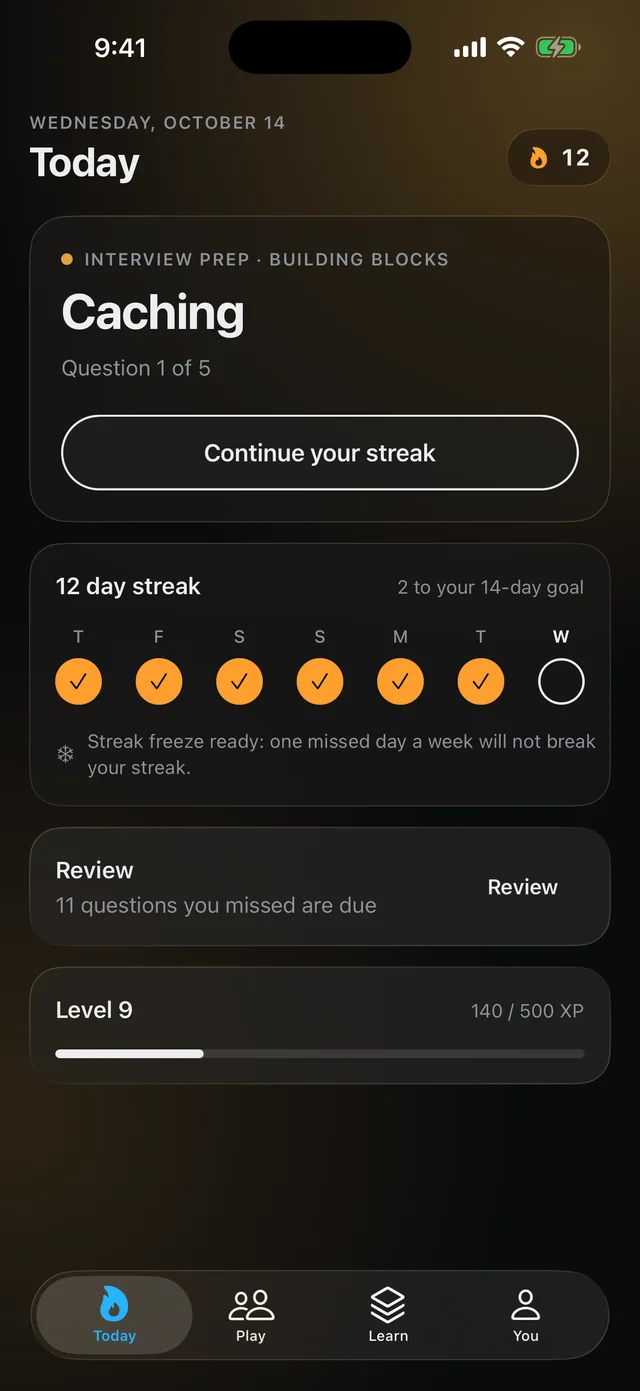
The Today tab.

Today

The day's practice, your streak and what is due for review.

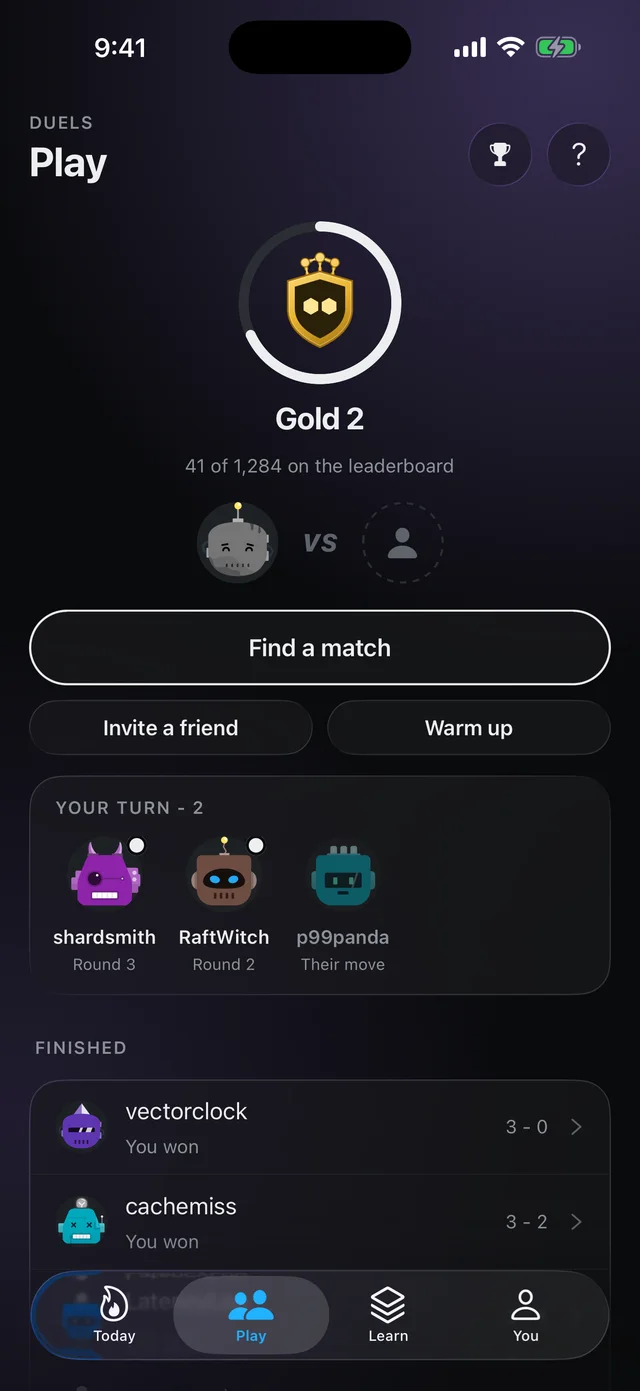
The Play tab.

Play

Your rank, your duels under way, and a way into the next one.

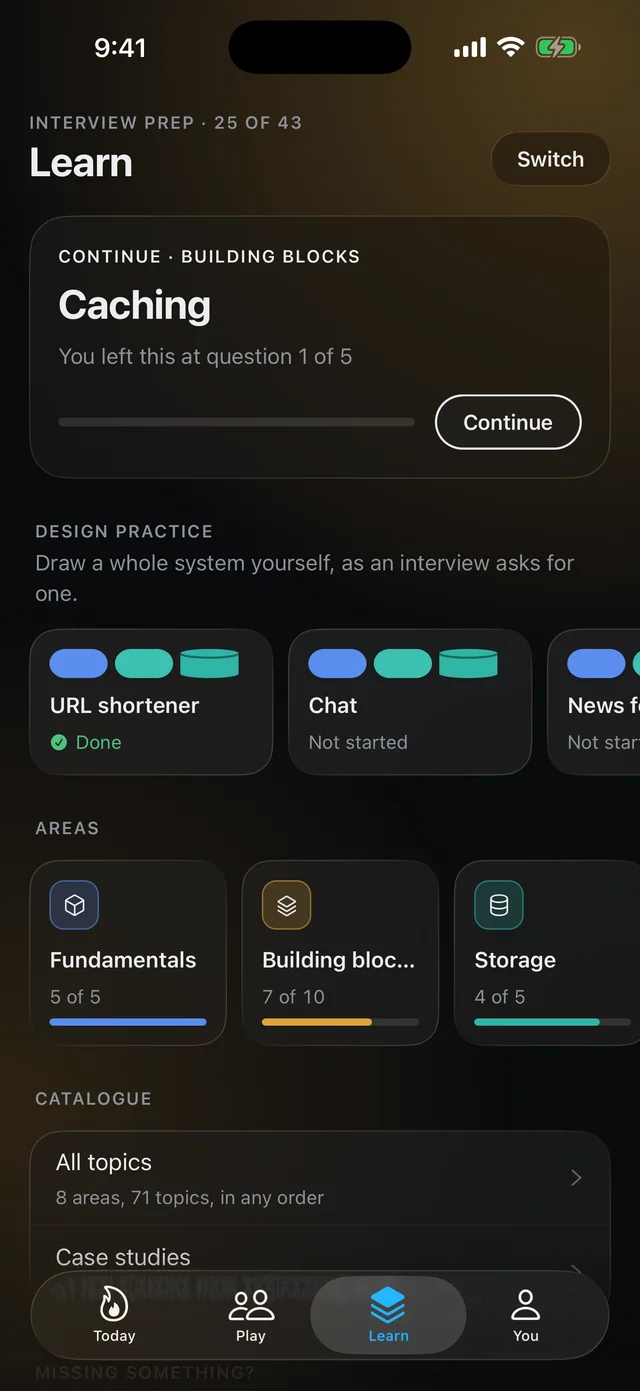
The Learn tab.

Learn

Your track, design practice, every area and the catalogue.

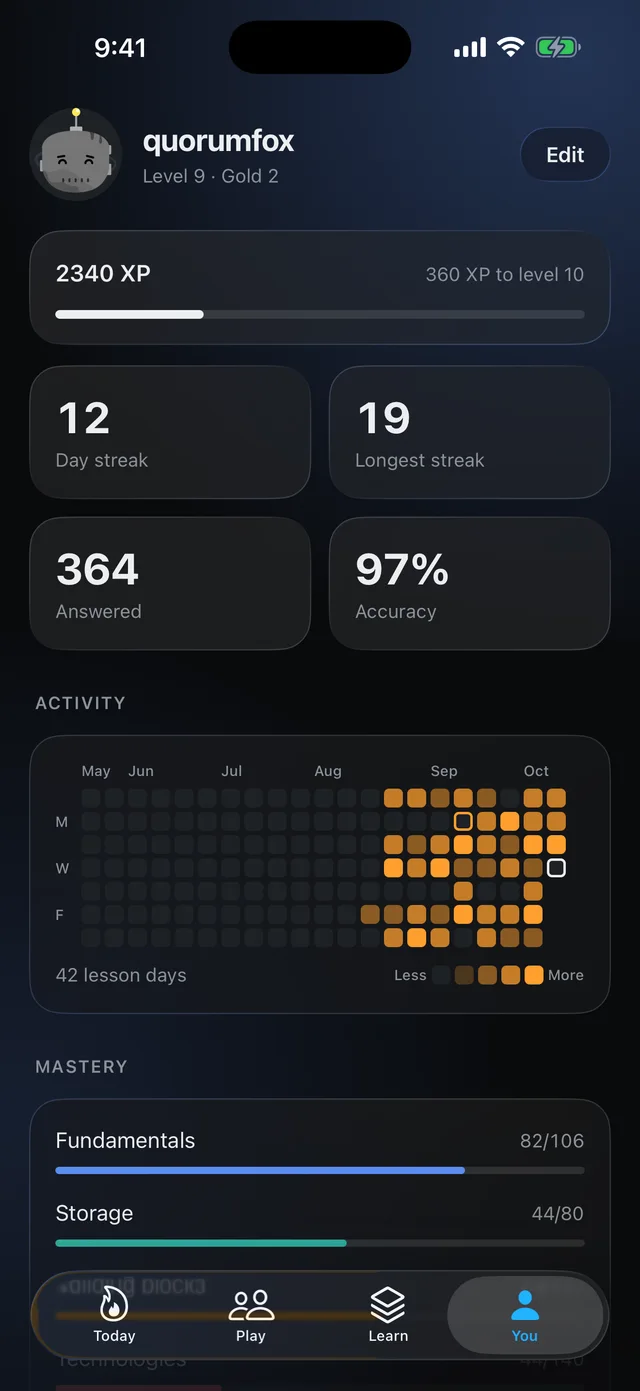
The You tab.

You

Level, activity, mastery by area, your account and settings.

Learn

Practice every day, and why each answer is right.

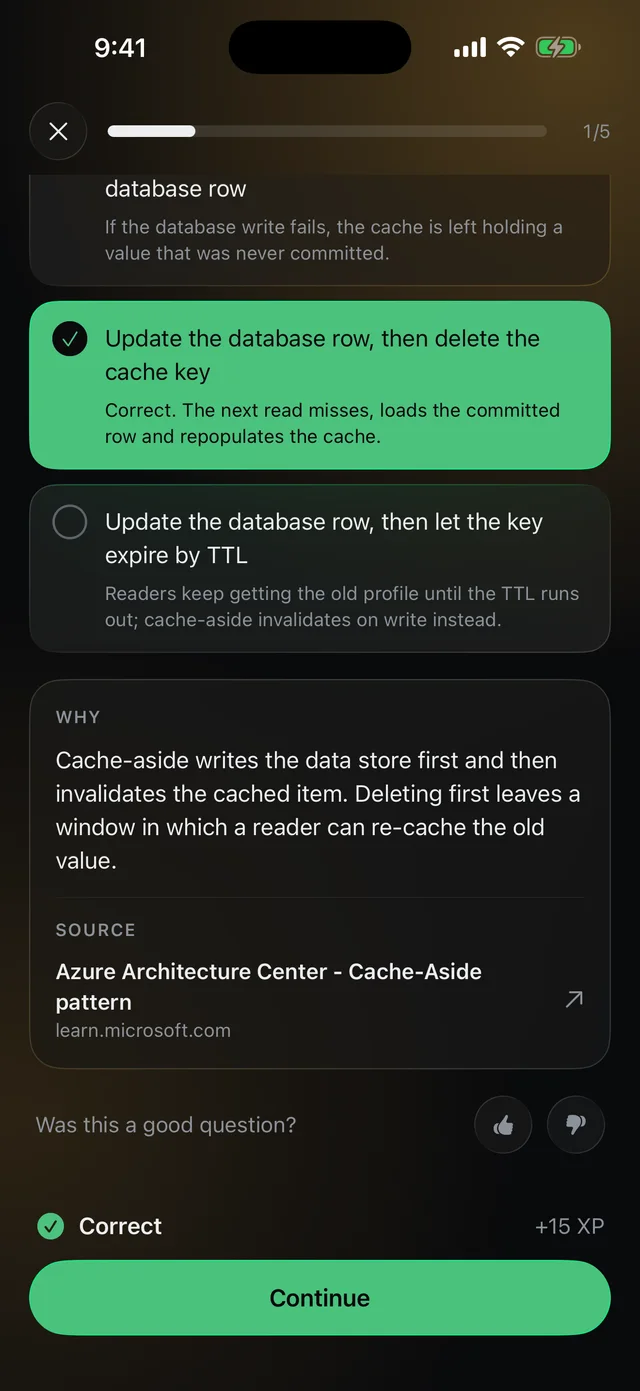
A practice set is five new questions on one topic, with up to two due for review. Each question is explained once you answer, option by option, with a link to the source it was checked against.

The plan carries on from where you stopped. Finish a topic and the next one on your track is tomorrow's practice.

A practice question after answering, with its explanation and source.

Tracks

A track is an order through the topics. Switch whenever you like.

  • Core curriculumFreeEvery area in teaching order, from the fundamentals to full designs.
  • Interview prepEstimation, the building blocks and the patterns, then the full designs.
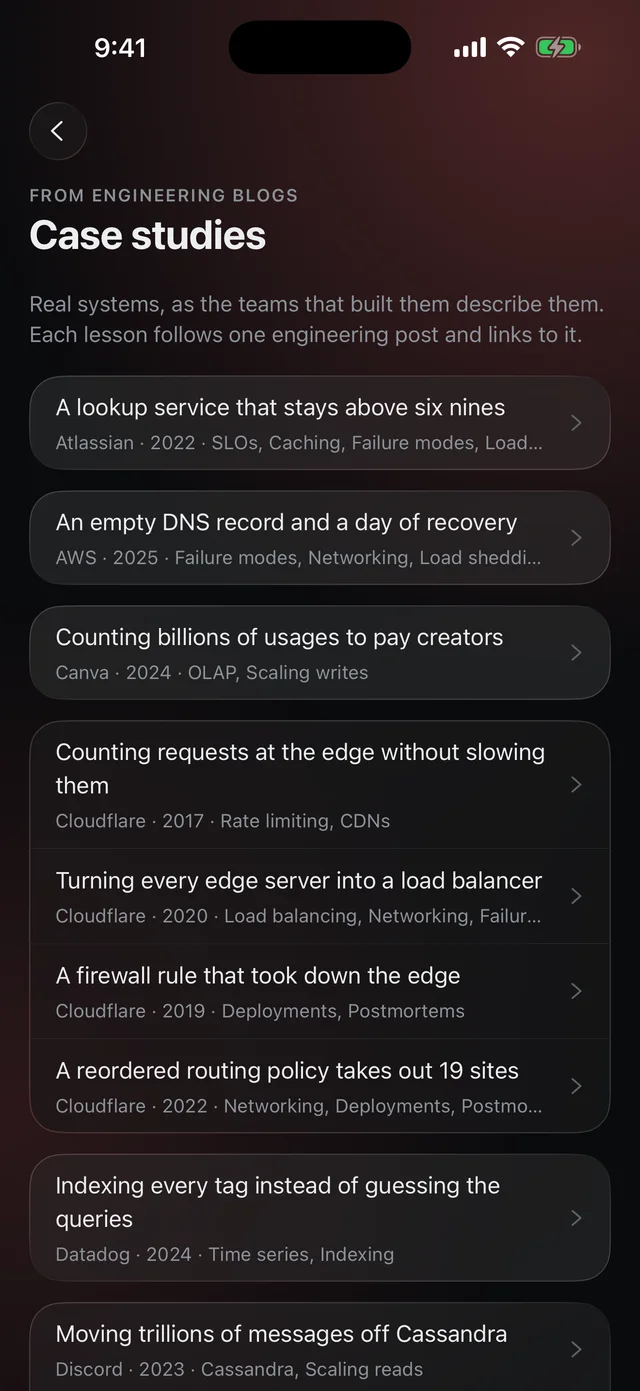
  • Case studiesReal systems from engineering blogs: what the team built, what broke, and what they changed.

Then there are platforms: the same ideas, as one provider's services.

Start where you are

Say where you are in your career, and the plan begins there.

  • Getting startedA student, or early in a career. Starts on the building blocks.
  • Working engineerBuilds and ships services. Starts on tradeoffs under real constraints.
  • Senior or staffLeads designs and reviews. Starts with failure modes and scale.

Many kinds of question

Not everything worth knowing fits four options.

  • Single choice
  • Select all
  • True or false
  • Number
  • Ordering
  • Matching
  • Tap the diagram

Three tiers

  • RecallDo you know what it is.
  • ApplyCan you use it on a real problem.
  • JudgeCan you choose between options that all look reasonable.

Primers

Every topic opens with three short cards that teach the idea before you are asked about it.

Missed questions come back

A question you get wrong returns the next day, then at widening gaps of 3, 7, 16 and 35 days, until it has stuck.

Area checkpoints

Ten questions mixed from across an area, no more than two from any topic, to check the whole of it holds together.

It keeps up with you

The app rates your skill in every topic from your first-try answers, and asks at the tier you are nearest: harder as you improve.

What it covers

70+ topics and 800+ questions, area by area.

From how a request crosses a network to how a payment system survives a retry. Every question is reviewed against its source.

Fundamentals

100+ questions

Networking, APIs, estimation, consistency.

  • API design
  • Consistency models
  • Consensus
  • Clocks and ordering
  • Estimation

Storage

80+ questions

Indexes, replication, sharding, transactions.

  • Indexing
  • Replication
  • Sharding
  • Consistent hashing
  • Multi-region

Building blocks

110+ questions

Caches, queues, load balancers, CDNs.

  • Caching
  • Message queues
  • Rate limiting
  • Distributed locks
  • ID generation

Technologies

140+ questions

Redis, Kafka, PostgreSQL and friends.

  • Redis
  • Kafka
  • PostgreSQL
  • Cassandra
  • DynamoDB
  • Kubernetes

Patterns

70+ questions

Contention, real-time, scaling reads and writes.

  • Real-time updates
  • Contention
  • Scaling reads
  • Scaling writes
  • Long-running tasks

Reliability

80+ questions

Failure modes, SLOs, deployments, postmortems.

  • Failure modes
  • SLOs
  • Load shedding
  • Observability
  • Disaster recovery

Full designs

150+ questions

URL shorteners, chat, feeds, ride sharing.

  • Chat
  • News feed
  • Ticketing
  • Payment system
  • Collaborative editor

Advanced

80+ questions

Geo search, time series, vectors, CDC.

  • Proximity search
  • Vector databases
  • Change data capture
  • CRDTs
  • OLAP

Platforms

The same ideas, as one provider's services.

A platform takes what the areas teach and shows where it lives in a real cloud: which service is the queue, which is the cache, and what each one will and will not do for you. AWS is the first.

AWS

180+ questions

S3, SQS, Lambda, Aurora and the services around them.

  • S3
  • Lambda
  • SQS and SNS
  • Aurora and RDS
  • Step Functions
  • Kinesis
  • CloudFront

Case studies

What real teams built, what broke, and what they changed.

30+ case studies, each a short run of linked questions that walks through one real system decision by decision.

They are drawn from write-ups published by teams at:

  • Atlassian
  • AWS
  • Canva
  • Cloudflare
  • Datadog
  • Discord
  • Dropbox
  • Figma
  • GitHub
  • LinkedIn
  • Meta
  • Notion
  • Roblox
  • Segment
  • Sentry
  • Shopify
  • Slack
  • Stripe
  • Uber
A case study in the app.

Design boards

Draw the whole system.

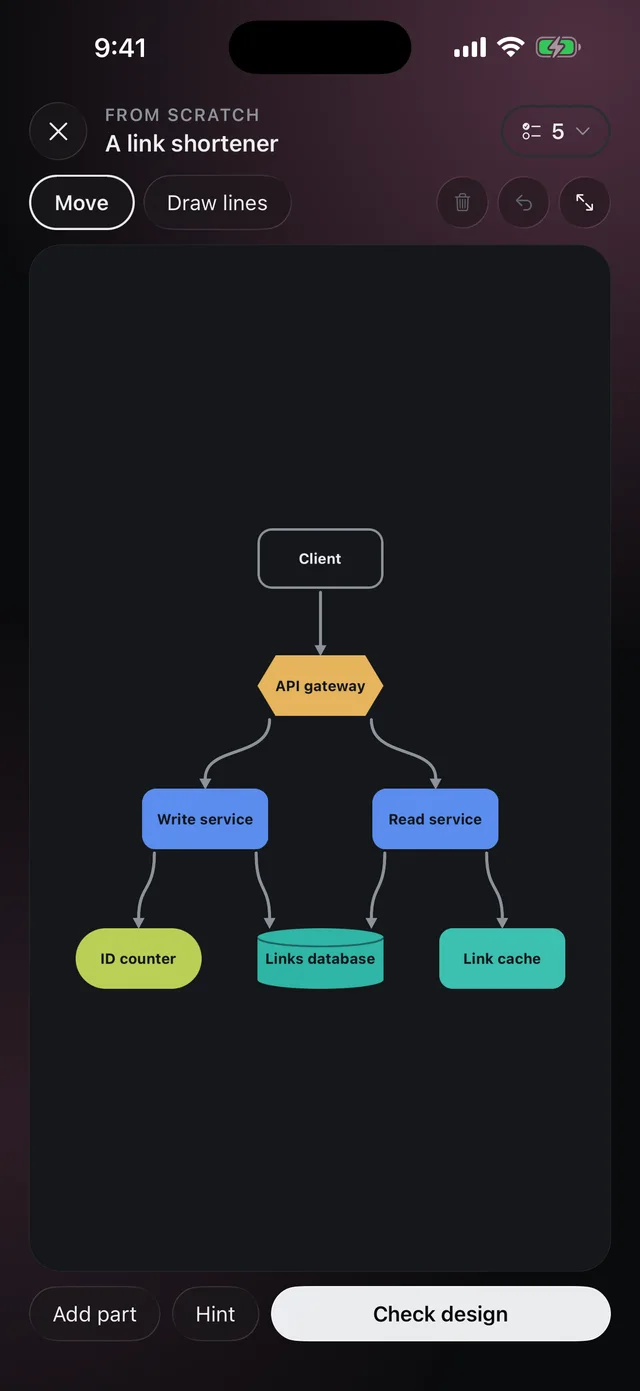
Whole systems to build on a whiteboard from parts and lines: clients, services, caches, queues, databases. Each board says what the system must do, and checks your drawing against it.

Stuck on a requirement? Ask for a hint. There are three for each, and each says a little more than the last. Give up and the board shows designs that work, usually more than one, because there is rarely a single right answer.

Once the drawing works, the board asks about the choices a drawing cannot show, such as how many replicas a part needs.

A link shortener drawn on the design board.

01

Fill the gaps

Most of the system is drawn. Add the pieces that are missing.

02

Find the flaws

A design that looks finished and is not. Find what is wrong with it and put it right.

03

From scratch

A client and a blank board, as in an interview.

The boards

  • A link shortener
  • A chat app for millions
  • A home feed for a social app
  • A ride-hailing service
  • Tickets for a sold-out show
  • A video site
  • A web crawler
  • A payment service
  • A notification service
  • Search suggestions as you type
  • A shared document editor
  • Files in sync across devices
  • A game's leaderboard

Duels

Three questions a round. Be right, then be quick.

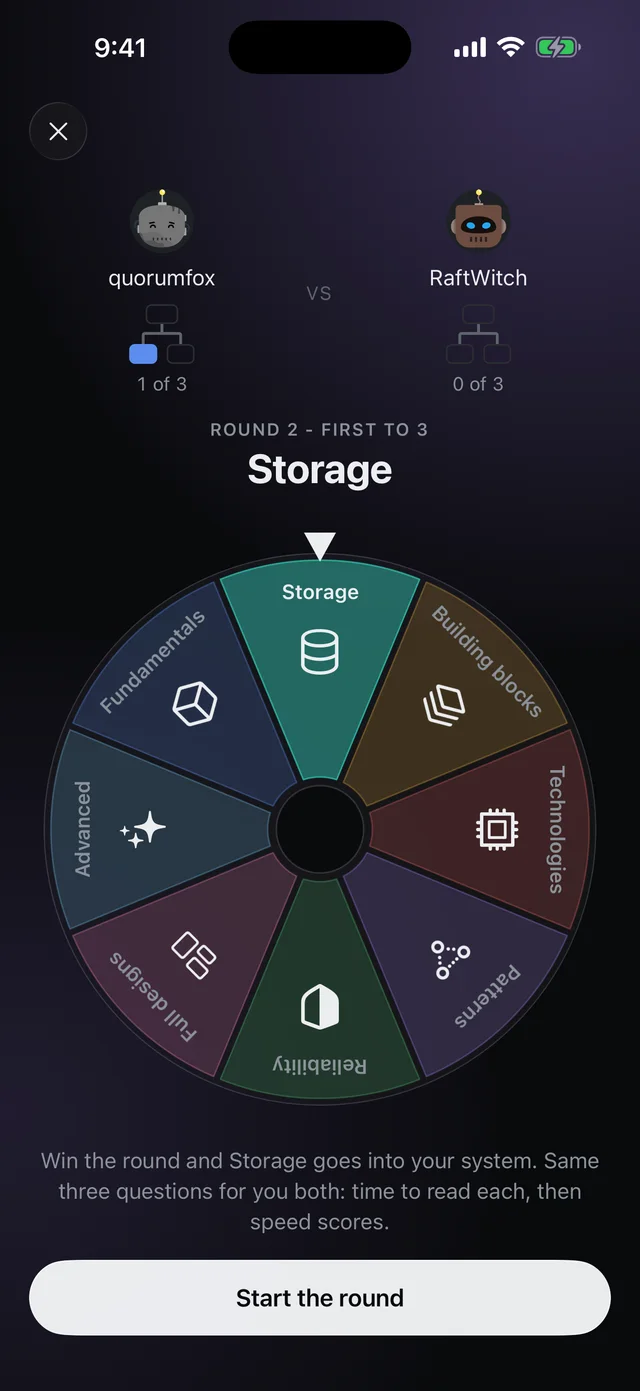
A duel is one engineer against another over the same questions. Every round is fought over one component of a system. Score more in the round and it is yours. The first to three components wins.

The wheel landing on an area for the round.
Spin
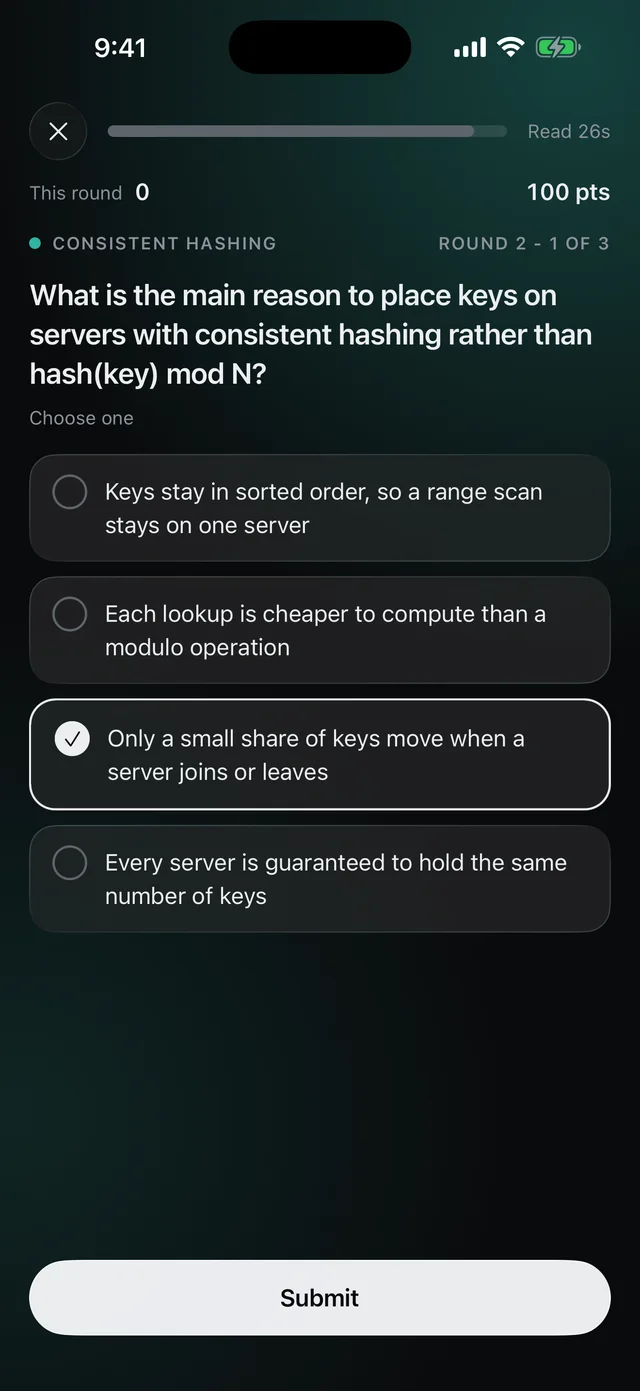
A timed duel question with one answer chosen.
Answer
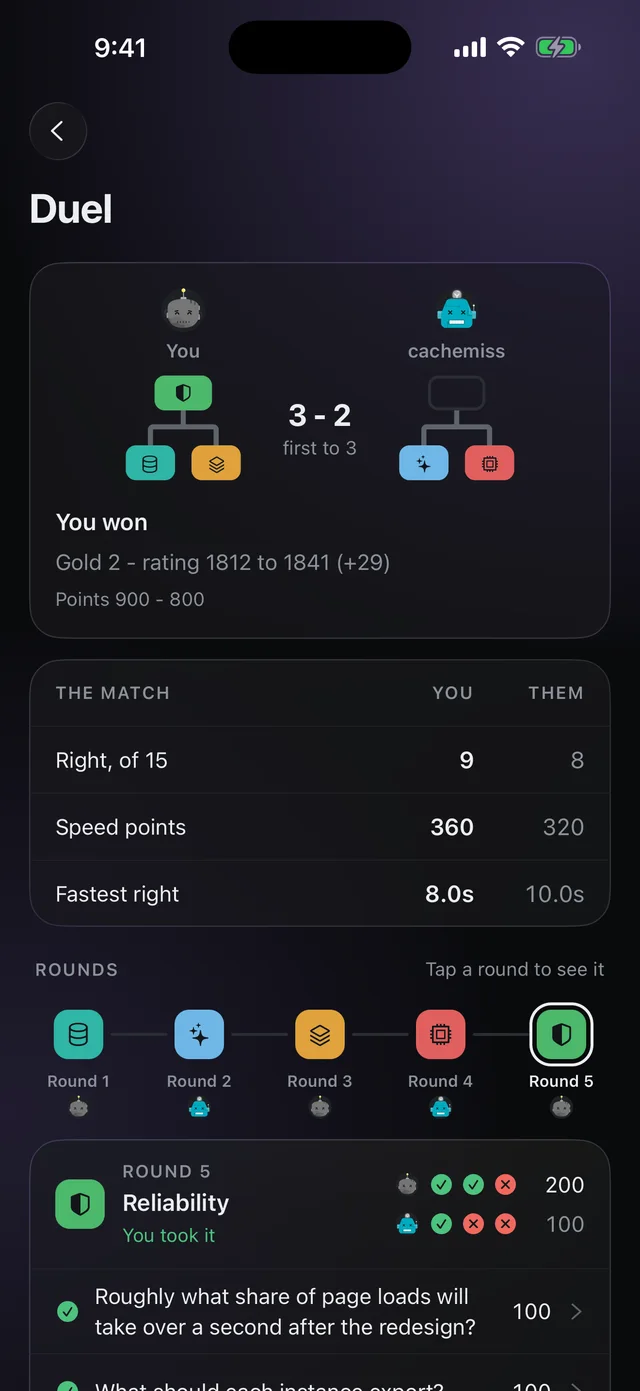
The match board: each player's system, round by round.
Take the round

How a duel works

3
components to win
3
questions a round
100
points a question

How you win

  • More points in a round takes its component.
  • Level on points, it goes to whoever took less time over their answers.
  • Nobody on 3 after 5 rounds: more components wins, then more points, then it is a draw.

A spin picks every round

Nobody chooses the area, and you both get the same questions. The wheel covers every general area. From round 2 it can land on a scenario: one system, settled one decision at a time.

Be right, then be quick

Every question gives you 10 to 60 seconds to read, by its length, and that costs nothing. Then a right answer is worth 60, plus up to 40 more the sooner it comes. Out of time counts as wrong.

Time to answer, once the reading time is up
30sTrue or false, single choice, number
60sSelect all, ordering, matching, diagram

Play in turns

No need to be online together. You each play a round when you have a moment, and the app tells you when it is your turn. Take longer than 48 hours over a turn and you forfeit.

Who you play

  • A player near your rank. The search takes up to a minute.
  • If nobody is free, a computer takes the match. Computers never appear on the leaderboard.
  • Or a friend, by invite link. A friendly is played the same way and does not count toward your rank.

Good to know

  • You see their answers for a round once you have both played it.
  • Resigning counts as a loss.
  • Up to 3 duels at once on the free plan.
  • Think a question is wrong? Report it from the question.
  • There is no chat. The only thing you send an opponent is your answers.
  • Warm up alone with untimed questions before you play.

The ladder

Bronze to Diamond.

Your first five duels are placement matches. After the last one you are shown your rank. From then on a win moves you up and a loss moves you down, and beating a stronger player moves you further.

  1. Bronze 1Bronze 2Bronze 3
    Bronze
  2. Silver 1Silver 2Silver 3
    Silver
  3. Gold 1Gold 2Gold 3
    Gold
  4. Platinum 1Platinum 2Platinum 3
    Platinum
  5. Diamond 1Diamond 2Diamond 3
    Diamond

Five ranks, three divisions each. Division 3 is the highest.

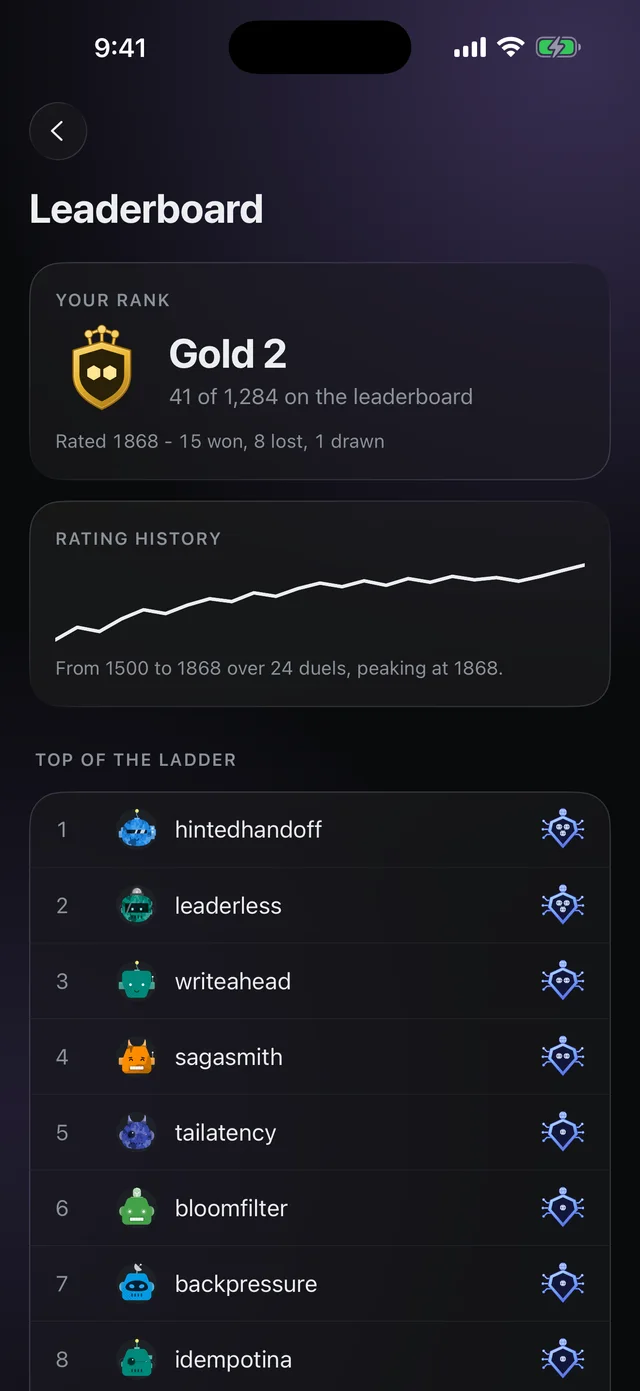
The leaderboard

Every placed player, in order of rating: the top of the ladder, and the players just above and below you.

Promotion

Cross into a new division and the result screen stops to show you the badge you have just earned.

The leaderboard.
Leaderboard
A duel won, the rating going up, and a promotion to Gold 2.
Promotion

Progress

A habit you can see.

The point is to come back tomorrow. The app keeps count so you do not have to.

  • StreakOne practice set a day keeps it. Aim for 7, 14 or 30 days.
  • Streak freezeMiss a day and the freeze covers it. One a week, on Pro.
  • XP and levelsRight answers earn XP. Each level takes a little more than the last.
  • ActivityA heatmap of the days you studied, and how much.
  • MasteryHow far through each area you are.
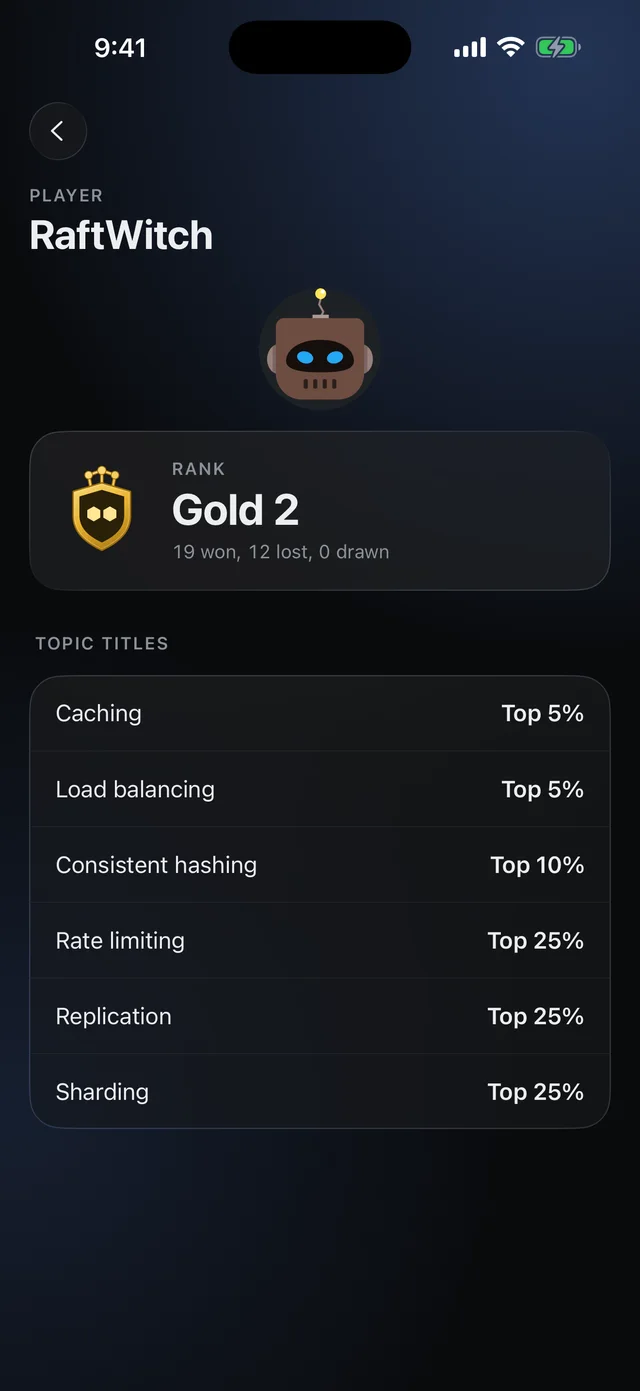
  • TitlesAnswer enough in a topic and your profile shows where you stand in it: Top 25%, 10%, 5% or 1%.
A player's profile: avatar, rank and topic titles.

Free and Pro

The daily habit is free. Pro adds depth, choice and volume.

Your daily practice, your streak and every explanation stay free. Nothing in Pro changes who wins a duel.

FeatureFreePro
Daily practiceOne set a day, on the Core curriculumUnlimited, on any topic, any time
Explanations and sources in practice●●
Streak, XP and levels●●
TracksCore curriculumEvery track
Platforms-AWS
PrimersFor the day's topicEvery primer
Case studiesOneAll of them
Design boardsOne, the link shortenerAll of them
ReviewInside the daily practiceReview sessions whenever you like
Area checkpoints-●
Practice on your weakest topics-●
Duels, rank and the leaderboard●●
Duels under way at onceUp to 3No limit
After a duel answerRight or wrong, and the correct answerEvery option's rationale, the explanation and the source
Rating history-●
Streak freeze-One a week

Pro is a subscription through the App Store. The app shows the plans and their prices before you buy.

Questions

The things people ask first.

Is it free?

Yes. One practice set a day with every explanation, your streak, duels, your rank and the leaderboard are free and stay free.

What does Pro add?

Depth, choice and volume: unlimited practice on any topic, every track, case study and design board, review sessions, the full explanation after each duel answer, your rating history and a streak freeze. It never changes who wins a duel.

Who is it for?

Anyone who designs software or wants to. You say where you are when you start, from student to staff engineer, and the plan begins there.

Is it only for interviews?

No. There is an Interview prep track, and it suits that well. The app is built for staying sharp in the job, which lasts longer than any interview.

Who do I duel?

A player near your rank, or a friend by invite link. If nobody is free within a minute, a computer takes the match.

Do we both have to be online?

No. Duels are played in turns, and each turn has 48 hours. The app tells you when it is yours.

Do I need an account?

Not for daily practice or design boards. Duels and the leaderboard ask you to sign in with Apple, which also backs up your progress.

Where do the questions come from?

Each one is written from a published source, such as official documentation or an engineering team's own write-up, and links to it.

What if a question is wrong?

Report it from the question. A person reviews every report, and a question reported by enough players is pulled from play until it has been checked.

Does it cover AWS?

Yes, as a platform of its own, with each topic tied to the general idea it is an instance of. Platform questions stay out of duels, which are played on the general areas.

Can I delete my account?

Yes, from the You tab. Everything we hold goes with it.

Something we did not answer? Ask us.

Start with today's practice.

Download on the App StoreComing soonAndroid